sexta-feira, 4 de março de 2016

Nb. Some DO have (a) Doctoral School[s]... -> The world’s top universities for attracting industry funding | Times Higher Education (THE)

The world’s top universities for attracting industry funding | Times Higher Education (THE):

Nb. Some DO have (a) Doctoral School[s]...

The world’s top universities for attracting industry funding

Times Higher Education World University Rankings data reveal the 20 best institutions based on private-sector investment per academic
March 3, 2016
Giant magnet attracting money
Source: Corbis
Germany’s LMU Munich receives more industry funding per academic than any other institution in the world, according to Times Higher Education’s new Funding for Innovation ranking.
The university has topped a list of the world’s best 20 institutions based on their ability to secure research money from the private sector. It secured almost $400,000 (£288,500) per academic from businesses in 2013.
The US’ Duke University takes second place, with a figure of almost $290,000, while the Korea Advanced Institute of Science and Technology (KAIST) is third, with $254,700.
Europe dominates the ranking with nine institutions in the top 20, followed by Asia with seven and North America with just two. China is the most-represented nation, with four universities, led by China University of Petroleum (Beijing), which received $227,600 of industry funding per academic, in seventh. Germany, South Korea, Turkey, the Netherlands and the US have two institutions each.
When assessing a country’s overall performance on this measure, Germany is top, with its best five institutions securing an average of $195,800 of industry investment per academic. It is followed by the US ($175,900) and China ($172,100).
The UK is conspicuous by its absence in the university ranking and comes 22nd in the top 30 list of countries – below Turkey, Belgium and Brazil – receiving under $28,000 of industry funding per researcher, based on the figures for its five best-performing institutions. The result comes just a week after THE reported that a survey of more than 18,000 UK academics had found that a dwindling number of scholars were commercialising their research.

Top university attractors of industry funds

RankInstitutionCountryIndustry income per academic (PPP $US)WUR 2015-16 rank
1LMU MunichGermany392,80029
2Duke UniversityUS287,10020
3Korea Advanced Institute of Science and Technology (KAIST)South Korea254,700148
4Johns Hopkins UniversityUS249,90011
=5Anadolu UniversityTurkey242,500601-800
=5Wageningen University and Research CenterNetherlands242,500=47
7China University of Petroleum (Beijing)China227,600601-800
8Pontifical Catholic University of Rio de Janeiro (PUC-Rio)Brazil204,600501-600
9Istanbul UniversityTurkey202,000601-800
10University of FreiburgGermany201,70084
11Peking UniversityChina198,80042
12National Cheng Kung UniversityTaiwan182,100401-500
13Pohang University of Science and TechnologySouth Korea172,800116
14KU LeuvenBelgium163,70035
15Stellenbosch UniversitySouth Africa156,600301-350
16Tianjin UniversityChina152,800501-600
17Tsinghua UniversityChina150,200=47
18Delft University of TechnologyNetherlands148,700=65
19Swedish University of Agricultural SciencesSweden144,200201-250
20University of BaselSwitzerland139,000=101
Notes: Income figures adjusted for purchasing power parity. Average income for country based on mean figure from top five universities for industry income in each country.
Source: THE DataPoints © THE data@timeshighereducation.com

Gerard Postiglione, director of the Wah Ching Centre of Research on Education in China at theUniversity of Hong Kong, said that China’s success could be attributed to its large number of state-owned enterprises, coupled with the fact that its “top-tier universities are all government funded”, while South Korea’s achievement of fourth place reflects that it is a “highly industrialised country”.
He added that the relocation of Hong Kong’s manufacturing industry to China in the 1980s could be one reason why the city “pales in comparison” in the list: it ranks 24th and there are no Hong Kong institutions in the university list.
Philip Altbach, founding director of the Center for International Higher Education at Boston College, added that US universities have strong links with industry for a number of reasons.
“First, some US universities pay a lot of attention to monetising intellectual property, and encourage their academics to think about this. Second, US universities are typically more flexible in terms of setting up interdisciplinary labs and other structures that make this kind of work possible. And third, some American academics, especially at top universities, think ‘entrepreneurially’,” he said.
The data for the THE Funding for Innovation ranking were extracted from the THE World University Rankings 2015-16. The indicator was defined as “research income from industry and commerce” and does not include public funding for universities.
Only countries with at least five universities in the THE rankings database were included, and only the top five institutions from each country were analysed. The data relate to the 2013 academic year, are presented in US dollars and are subject to purchasing power parity normalisation.

Average industry income per academic by country
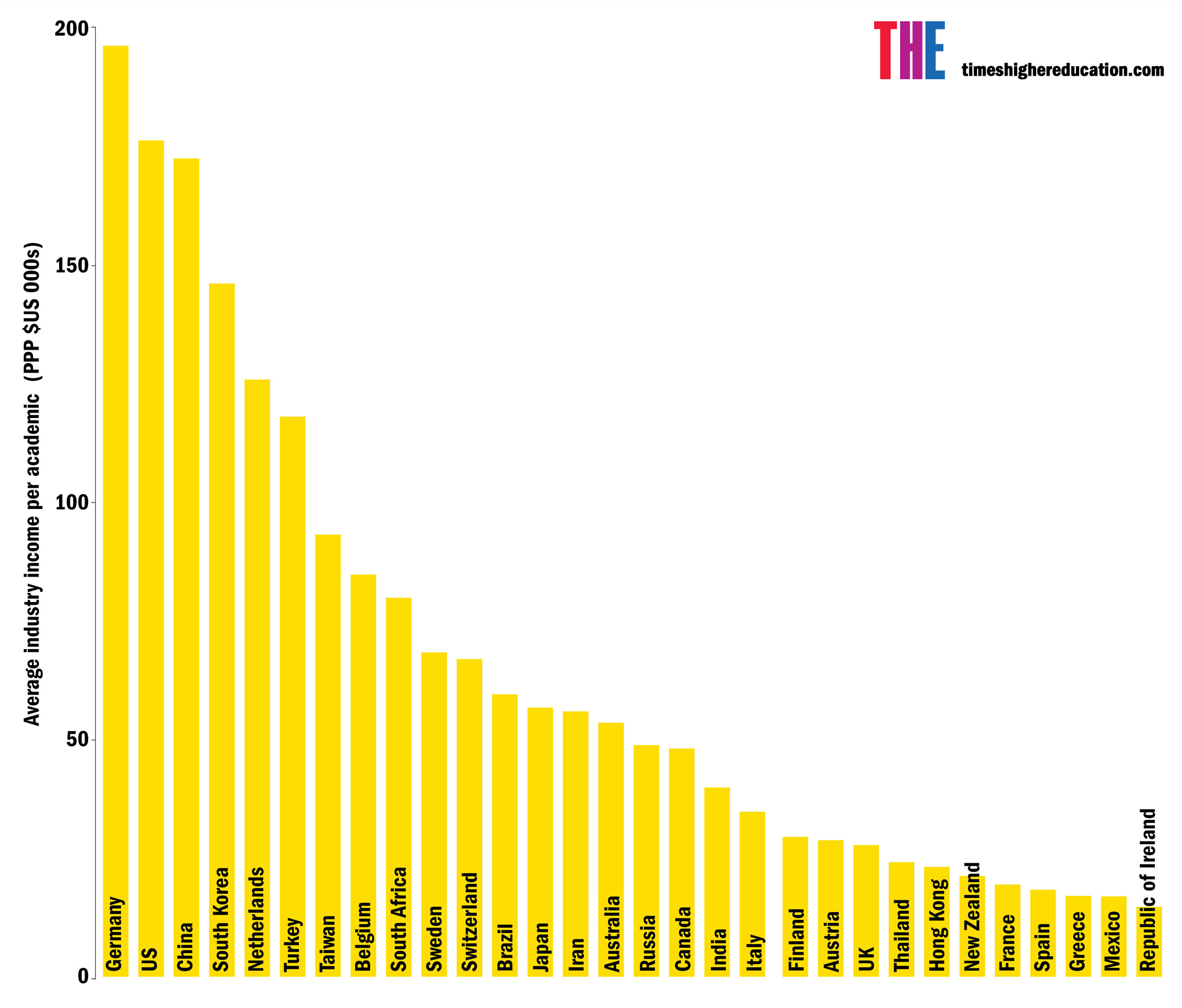

Average industry income per academic by country

What is the winning formula for innovation funding?

Johns Hopkins University, which received $250,000 of industry funding per academic in 2013, sees the majority come from pharmaceutical companies for its School of Medicine and its Bloomberg School of Public Health.
One recent research project saw the institution collaborate with MedImmune, the biologics research and development arm of AstraZeneca, on a $6.5 million initiative that looked into respiratory problems, oncology, infectious disease and antibody discoveries.
Christy Wyskiel, senior adviser to president Ronald J. Daniels and part of the Johns Hopkins Technology Ventures unit, said that there had been more interest in marketing research in the past few years – and in ensuring that these lessons were passed on to students.
“We have a business school with a course called ‘Discovery to Market’, where students learn how to bring a product to the market,” she said.
“As a university, we are very focused on student experience, and in addition to being able to work in some of the most world-renowned labs they can also contribute through internships and are exposed to entrepreneurship.”
Duke University also has a close relationship with the medical and pharmaceutical industries through its Clinical Research Institute, which has more than 1,200 employees who work mostly on large clinical trials for new drugs. The institute’s total revenue is more than $200 million, 35 per cent of which comes from federal or other institutional funding, while the rest comes from industry research streams, said its director Eric Peterson.
“I think there are two reasons we got to this position. We are leaders in this field, and industry figures seek us out now,” he said.
“But many of us also work closely with government. Our actual founder, Rob Califf, is now to be the new head of the Food and Drug Administration, for example."
Jess Staufenberg

'via Blog this' The Honourable Schoolboy

Top 100 universities with the best student-to-staff ratio | Times Higher Education (THE)

Top 100 universities with the best student-to-staff ratio | Times Higher Education (THE):

Students and a teacher in the classroom

'via Blog this' The Honourable Schoolboy

Scientists claim cure for cancer is closer | The Times

Scientists claim cure for cancer is closer | The Times: "British scientists could treat or even cure cancer using a groundbreaking technique that finds and attacks the “Achilles’ heel” of tumours, they say. Research by University College London harnesses the body’s immune system to wipe out each cancer cell in a “potentially revolutionary” way. It promises to be effective against fast-mutating types of the disease, such as lung cancer, that have so far evaded most treatments. Scientists are hopeful that it will work on all cancers. Researchers involved in the latest breakthrough warned that the work was in its early stages and trials were needed before it could be used to treat patients. Charles Swanton, from the UCL Cancer Institute, said: “I will be disappointed if we haven’t treated a patient [in a trial] within two years.” About 160,000 people die from cancer each year in the UK, accounting for almost a third of all deaths. Half are from lung, bowel, breast and prostate cancer. The research, published in the journal Science, describes a method for creating individualised cancer treatments by finding a key change common to all cells in a person’s tumour and mobilising the immune system to fight it. Peter Johnson, from Cancer Research UK, said that the work was very exciting. “[It is about] understanding at a fundamental molecular level what it is that the immune system can see in tumours, leading to effective treatments. We have big optimism about what it will deliver.” In a video introducing the study, Cancer Research UK, which helped to fund the work, described how the technique encouraged immune cells to attack mutations common to every tumour cell. “They could form a fierce cancer- fighting force with the potential to target every cancer cell in the body . . . if their promise holds true it could prove a revolutionary way to treat or even cure cancer,” the video said. In healthy people, the immune system attacks and destroys cancer cells. When a tumour forms, it represents a failure of the body’s abilities to defeat the cancer naturally. Researchers around the world have been looking for ways to help the immune system in its fight but one of the difficulties has been that any one cancer continuously mutates. As it does so, it outpaces the immune system’s abilities to locate it. Equally, even if scientists are able to train the T-cells of the immune system to find it and destroy it at one point, the chances are that some cells will have already mutated sufficiently to be impervious. The researchers said they had been able to identify the earliest mutations in two lung cancer biopsies as well as the antigens that they produce on the cell’s surface. Because these antigens represent mutations common to all later cells, it gives the scientists a fixed target. At the same time, they have found T-cells in the tumour that already attack those antigens but which are not present in sufficient quantity to make a difference. In theory these could be cultivated to kill all the cells. “The tumour has already sown the seeds of the tumour’s own destruction,” said Professor Swanton, a co-author of the paper. His colleague Sergio Quezada said that the goal was either to grow the T-cells in large enough quantities in the laboratory before putting them back into the patient, or to encourage the patient’s body to make them using a vaccine. “We can work to boost numbers, to get more of those cells, increase the number within the army, and then we’ll destroy the tumour,” he said. Under the treatment, patients would have a biopsy, which would then be genetically analysed to identify the tumour cells to target. One advantage of the technique is that, in theory, it works best in cancers that mutate rapidly, such as lung cancer. Until now, these have been harder to treat because of their high mutation rate. The research will now be extended to see if it can work in all tumours. The scientists conceded that the treatment would be costly. Since each cancer is unique, interventions would need to be tailored to individual patients using biopsies of their tumours. “This is not going to be cheap,” Professor Swanton said. “But cancer care is already incredibly expensive. And what if you balance it against getting a patient back into the workplace in their mid-40s? I would hope we can do this in a very cost-effective way.”"


'via Blog this' The Honourable Schoolboy

Give teachers career breaks to stop them quitting, say heads | The Times

Give teachers career breaks to stop them quitting, say heads | The Times:

Teacher helping students

'via Blog this' The Honourable Schoolboy

@ ICI: Gravitational Waves from Cosmic Strings

@ ICI:

http://www.ubi.pt/Sites/ICI/pt/Evento/139

Img:

'via Blog this' The Honourable Schoolboy

I’d be more afraid to stay in the EU than to leave | Red Box

I’d be more afraid to stay in the EU than to leave | Red Box:

Frank Underwood

'via Blog this' The Honourable Schoolboy

Ciência - O velhinho Hubble ainda bate recordes de distância cósmica - Sociedade - DN

Ciência - O velhinho Hubble ainda bate recordes de distância cósmica - Sociedade - DN:


'via Blog this' The Honourable Schoolboy

quinta-feira, 3 de março de 2016

Investigadora da UBI nomeada para Prémio Nacional @ UBI

Investigadora da UBI nomeada para Prémio Nacional @ UBI:

Img:

'via Blog this' The Honourable Schoolboy

Physics Reports | Vol 619, Pgs 1-24, (11 March 2016) | ScienceDirect.com

Physics Reports | Vol 619, Pgs 1-24, (11 March 2016) | ScienceDirect.com:

Physics Reports
Volume 619, Pages 1-24 (11 March 2016)

 
A review of Higgs mass calculations in supersymmetric models

Nb. A must read, indeed!!

Physics Reports

'via Blog this' The Honourable Schoolboy

Financiamento do Ensino Superior: o ponto de inflexão? - PÚBLICO

Financiamento do Ensino Superior: o ponto de inflexão? - PÚBLICO: "Financiamento do Ensino Superior: o ponto de inflexão? JOSÉ FERREIRA GOMES 03/03/2016 - 01:00 A manutenção da dotação do ensino superior estava prevista no Programa de Estabilidade. A continuidade merece um aplauso, mas..."


Temos um sistema de ensino superior que recebe já mais de 40% dos jovens (20 anos) e que vai cumprir o objetivo da União Europeia de termos 40% de diplomados (faixa etária 30-34 anos) em 2020. Todos os sinais apontam para uma qualidade educativa comparável com o que de melhor há na Europa. Os resultados da investigação e da transferência de conhecimento para a sociedade também se ajustam aos padrões europeus mais maturados.
As opções oferecidas aos candidatos são bastante diversas, entre licenciaturas profissionalizantes politécnicas, licenciaturas ou mestrados integrados universitários e os cursos de Técnico Superior Profissional (TeSP) criados em 2014. Estes últimos ciclos de estudos, vocacionados para a entrada mais rápida na vida ativa, representam uma alternativa já consolidada na generalidade dos países europeus e da América do norte e espera-se que possam muito rapidamente atrair cerca de 10% da coorte de jovens que termina o secundário e também muitos ativos em primeiro acesso ou em regresso ao ensino superior para rapidamente reorientarem o seu percurso profissional.
Esta área de expansão do ensino superior é particularmente importante como resposta ao número crescente de jovens que terminam o ensino secundário, agora em escolaridade obrigatória, e que, tendo optado por uma via não académica, querem ir mais longe no seu percurso educativo. Os institutos politécnicos fizeram um excelente trabalho no lançamento destes cursos, criando uma vasta oferta, sempre muito próxima das necessidades de quadros intermédios nas suas regiões.
Como acontece noutros países, a elevada empregabilidade destes diplomados do ensino superior vai dar-lhes um forte reconhecimento social e será para muitos o início de um percurso que pode ir mais longe. Particularmente fora dos grandes centros urbanos, os institutos politécnicos e os autarcas viram imediatamente a importância deste novo formato de ensino superior para o desenvolvimento das suas regiões.
Anuncia-se agora um aumento de 2,6% no orçamento do ensino superior para 2016 e apresenta-se esta proposta como um ponto de inflexão na evolução das dotações públicas para este setor. Não houve portanto uma descontinuidade. Não foi alterado o ritmo de variação das dotações. Terá sido alterada uma segunda derivada que não é verificável de momento. O certo é que a dotação para as instituições mantém o valor do ano anterior.
Constata-se, portanto, que foi usado um simples critério histórico para o rateio da dotação atribuída ao conjunto das universidades e institutos politécnicos públicos. Ora, esta estratégia penaliza as instituições que se tornaram mais eficientes ou que se desenvolveram nos anos mais recentes e não transmite quaisquer estímulos à melhoria. Os reitores de universidades e presidentes de institutos politécnicos têm desenvolvido grandes esforços para melhorar a qualidade dos serviços educativos prestados, para responder às necessidades sociais de educação e de investigação. Uma estratégia orçamental cega dificulta os esforços dos responsáveis para melhorar o desempenho das suas instituições e não dá quaisquer orientações de política educativa. Também a penalização imediata das instituições que apresentem algum desequilíbrio financeiro é injusta e imerecida porque resulta muitas vezes de causas fora do controlo da instituição e impossível de corrigir de imediato. Não era necessário.
A manutenção da dotação do ensino superior estava prevista no Programa de Estabilidade apresentado na Assembleia da República e transmitido a Bruxelas em Abril de 2015. O crescimento da Ação Social acompanha o que veio a acontecer já nos últimos anos e o que foi prometido aos estudantes em 24 de março de 2015 e inserido três meses depois no Regulamento de Bolsas de Estudo. A dotação agora proposta decorre desse processo. A continuidade merece um aplauso.
Recorde-se, porém, que o modelo de financiamento consensualizado com o CRUP e o CCISP na Primavera de 2015 dava a garantia de estabilidade e de previsibilidade das dotações. Demonstrava que em cinco anos deveria ser possível fazer convergir todas as instituições para o novo modelo com um esforço sério, mas sem quaisquer traumas. O crescimento do número de estudantes que estava previsto ajudaria à estabilização das instituições em maior dificuldade. Criavam-se estímulos a uma boa gestão e mecanismos de articulação da rede que têm sido pedidos por reitores, presidentes e muitos analistas.
O modelo incorporava uma componente de contratação plurianual com cada instituição que se assumiria plenamente terminado o período transitório. As instituições localizadas em regiões de menor dinamismo demográfico viram no modelo uma oportunidade para se integrarem serenamente num modelo nacional de financiamento onde o seu bom desempenho em ciclos curtos e licenciaturas mais bem desenhadas para a entrada no mercado de trabalho poderia dar-lhes a almejada estabilidade financeira. Tudo isto fica adiado.
Secretário de Estado com a tutela do Ensino Superior no XIX e XX Governos constitucionais

'via Blog this' The Honourable Schoolboy

Brasil blue's.....

From The Economist Espresso: Direr for Dilma: Brazil’s shrinking economy http://econ.st/1WVbMY1