segunda-feira, 4 de outubro de 2021

This is going to get very VERY excting! Squeezing down the Theory Space for Cosmic Inflation

The Honourable Schoolboy 


'' ... The likelihood analysis yields the constraint 
r0.05<0.036 at 95% confidence. Running maximum likelihood search on simulations we obtain unbiased results and find that σ(r)=0.009
. These are the strongest constraints to date on primordial gravitational waves.''


This schematic shows the new constraints from BICEP/Keck (red) on r, the tensor-to-scalar ratio, and ns, the scale dependence of the density fluctuations. Also shown are the predictions from certain inflation models: monomial or power-law models (blue) and Starobinsky-inspired models (green). The horizontal lines depict the expected sensitivities of future experiments: the Simons Observatory (yellow) and the CMB-S4 experiment (light blue). 

https://physics.aps.org/articles/v14/135


https://journals.aps.org/prl/abstract/10.1103/PhysRevLett.127.151301 

Text in full: 

Squeezing down the Theory Space for Cosmic Inflation

    Daniel Meerburg
    • Faculty of Science and Engineering, University of Groningen, Groningen, Netherlands
• Physics 14, 135
An updated search for primordial gravitational waves has not found a signal, which implies that some popular early Universe models are becoming less viable.
Steffen Richter/Harvard University
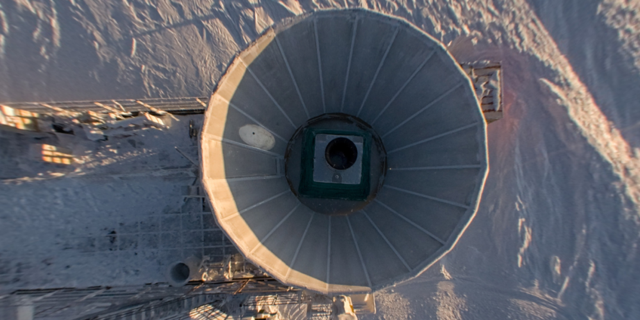
Figure 1: An aerial view of the BICEP2 experiment at the South Pole.

Remarkably, the large-scale Universe can be adequately described by a model involving only a handful of parameters. This lambda cold dark matter (LCDM) model postulates that the expansion of the Universe is driven by the presence of two dark components—dark energy and dark matter—and that the galactic structure we observe today was sourced by small density variations in the very early Universe. However, cosmologists expect that these primordial density fluctuations were accompanied by fluctuations in the fabric of spacetime itself. These gravitational waves could be observed through a predicted signal in the cosmic microwave background (CMB). The BICEP/Keck Collaboration, which has been a frontrunner in the search for this illustrious signal, reports on its latest data set, finding no evidence of gravitational waves [1]. The resulting limits push up against model predictions, which suggests that we are either quickly closing in on a detection or that we may soon witness a paradigm shift. In addition, the analysis shows that researchers properly understand the astrophysical contaminants that obscure the search for this relic signature. By reducing uncertainties about this contamination, we should have greater confidence in any future claims of a detection.

A robust detection of relic gravitational waves would confirm that our Universe was likely shaped by a mechanism known as inflation. Inflation was introduced in the early 1980s to solve some of cosmology’s biggest conundrums, and to this day, it is the most widely accepted and plausible theory of the early Universe. If that theory is correct and gravitational waves filled the early Universe, then cosmologists expect a distinct pattern, called B modes, should be imprinted in the CMB [2]. In 2014, the BICEP experiment at the South Pole (Fig. 1) reported possible evidence of B modes, but the signal turned out to be merely a result of dust in our own Galaxy producing CMB-like radiation. While this was a disappointment, it concentrated efforts on the dust problem (see Hunting Season for Primordial Gravitational Waves).

In principle, the CMB and dust can be distinguished because they differ spectrally. Over the years, researchers from the BICEP experiment and a joint project called the Keck Array have developed dust models using data at different frequencies. By removing the estimated dust contribution, the BICEP/Keck Collaboration has been able to place a progressively tightening bound on the gravitational-wave contribution. This bound is typically given in terms of the tensor-to-scalar ratio r, which characterizes the amplitude of gravitational waves relative to that of density waves. Before BICEP/Keck, the tensor-to-scalar ratio was known to be less than 0.11, based on CMB observations by the Planck satellite [3]. With BICEP/Keck data, the bound dropped to r<0.09 in 2016 [4] and then to r<0.07 in 2018 [5]. The latest result reduces the upper bound by almost a factor of 2, r<0.036 [1]. The BICEP/Keck team have shrunk this limit by combining data at three frequencies (96 GHz, 150 GHz, and 220 GHz) from their own experiment, complemented by archival data from the WMAP and Planck satellites.

Before commenting on the theoretical implications of this new upper limit, it is important to note how promising the latest analysis is for detecting a signal in the future. Since the foregrounds are the limiting factor to detection, accurate dust modeling is critical. Dust models are primarily based on high-frequency observations by the Planck satellite (the 353-GHz data to be precise). Dust becomes less important at lower frequencies, but for a small tensor-to-scalar ratio r, dust is still the strongest signal on the sky. If dust is more complicated than presently assumed, its modeling would need even more frequencies, or worse, perhaps the dust is too complicated to be modeled at all! For the first time, the observations place constraints on all the parameters of the dust model, and the team’s analysis shows that the model is accurately capturing the behavior of the dust. This is exciting news, as it suggests that we are in good shape when it comes to removing dust contamination and well equipped to make a detection if the signal is large enough.
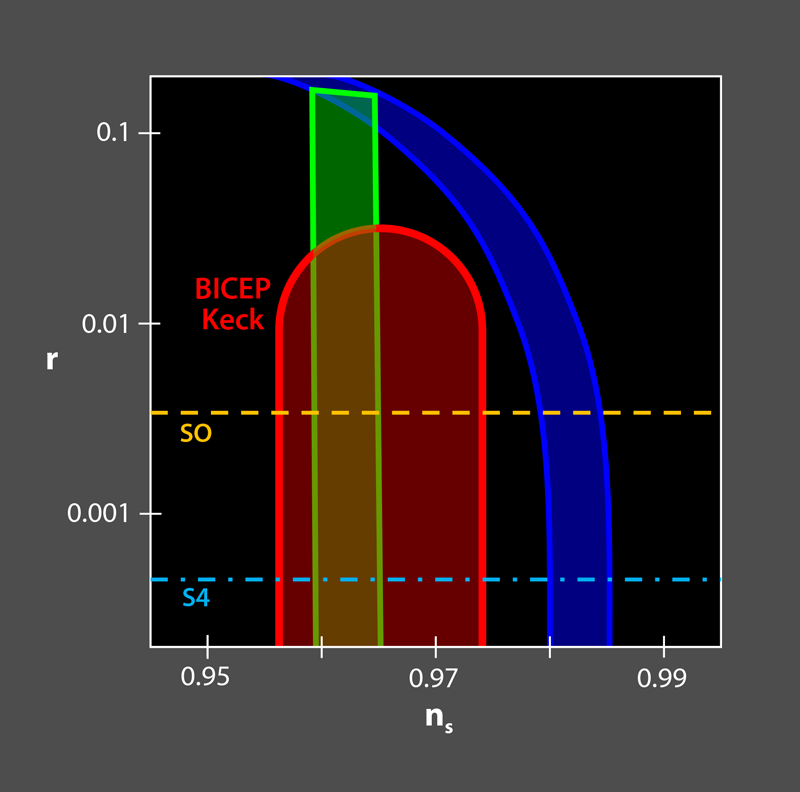
Figure 2: This schematic shows the new constraints from BICEP/Keck (red) on r, the tensor-to-scalar ratio, and ns, the scale dependence of the density fluctuations. Also shown are the predictions from certain inflation models: monomial or power-law models (blue) and Starobinsky-inspired models (green). The horizontal lines depict the expected sensitivities of future experiments: the Simons Observatory (yellow) and the CMB-S4 experiment (light blue). Show Less

These experimental efforts on dust removal are paying off, as the new bounds on the tensor-to-scalar ratio are having an impact on inflationary models. Different inflation models make different predictions for r, as the ratio is tied to the energy scale of inflation. One way to compare models with data is in a ns vs r plot, where ns is the scale dependence of the density fluctuations coming out of the inflation epoch (Fig. 2). The value that r takes within a particular inflation model is partly dependent on the amount of expansion before the end of inflation, characterized by the number N of e-folds (one e-fold corresponds to a stretching of space by a factor of e2.71). To solve the cosmological conundrums that inflation was designed to solve, N has to be at least 40, while values larger than 60 are inconsistent with measurements of ns. For a large class of popular models broadly referred to as monomial or power-law models, the tensor-to-scalar ratio is relatively large and scales as 1N [6]. We can now comfortably start to rule out this class of models. For another class of inflationary models, inspired by the work of Alexei Starobinsky in the early 1980s [7], the tensor-to-scalar ratio scales as 1N2 , leading to a smaller value of r that is within the new bounds from BICEP/Keck. Other models exist having r1Nt with t>2; however, those models tend to predict a value of ns inconsistent with current bounds.

So, some inflation models remain viable, but most of the popular models predict r>104 . While the new BICEP/Keck bound is still over 2 orders of magnitude away from this threshold, the rapid improvement over the last few years, combined with a much better understanding of the foregrounds, suggest we should soon be able to reach this theoretically well-motivated threshold. The future thus looks bright. Besides continued efforts by BICEP/Keck in close collaboration with the South Pole Telescope (SPT), the Simons Observatory (SO) in Chile, and later on, the CMB-S4 experiment (a joint effort by the SO and SPT/BICEP groups) will guarantee that we will reach the experimental sensitivity needed to measure r as low as 104 perhaps before the end of this decade. In addition to these ground-based experiments, a Japanese-led satellite mission, called LiteBIRD, will be launched in 2028. Satellites can observe the largest scales in our Universe, allowing them to probe a slightly later epoch than possible with ground observatories. If a detection is made, the combination of ground and space experiments will be paramount for confirmation. If, however, future measurements continue to find no gravitational-wave signal, it will likely imply that we must seriously reconsider our inflationary models or perhaps dismiss inflation altogether [8], which would be a significant paradigm shift.

References

  1. P. A. R. Ade et al. (BICEP/Keck Collaboration), “Improved constraints on primordial gravitational waves using Planck, WMAP, and BICEP/Keck observations through the 2018 observing season,” Phys. Rev. Lett. 127, 151301 (2021).
  2. M. Kamionkowski et al., “A Probe of Primordial Gravity Waves and Vorticity,” Phys. Rev. Lett. 78, 2058 (1997).
  3. P. A. R. Ade et al. (Planck Collaboration), “Planck 2013 results. XXII. Constraints on inflation,” Astron. Astrophys. 571, A22 (2014).
  4. P. A. R. Ade et al. (Keck Array and BICEP2 Collaborations), “Improved constraints on cosmology and foregrounds from BICEP2 and Keck Array cosmic microwave background data with inclusion of 95 GHz band,” Phys. Rev. Lett. 116, 031302 (2016).
  5. P. A. R. Ade et al. (Keck Array and BICEP2 Collaborations), “Constraints on primordial gravitational waves using Planck , WMAP, and new BICEP2/Keck observations through the 2015 season,” Phys. Rev. Lett. 121, 221301 (2018).
  6. V. Mukhanov, “Quantum cosmological perturbations: predictions and observations,” Eur. Phys. J. C 73, 2486 (2013).
  7. A. A. Starobinsky, “A new type of isotropic cosmological models without singularity,” Phys. Lett. B 91, 99 (1980).
  8. J. Khoury et al., “Ekpyrotic universe: Colliding branes and the origin of the hot big bang,” Phys. Rev. D 64, 123522 (2001).

segunda-feira, 20 de setembro de 2021

18th MultiDark Consolider Workshop

The Honourable Schoolboy 

18th MultiDark Consolider Workshop


October 18-20, 2021, La Rábida, Huelva (conditioned to the Covid pandemic situation)


Up to now science has failed to identify what makes up to 85% of the matter of the Universe. Elucidating the nature of dark matter constitutes a key challenge in modern physics. MultiDark is a Consolider Network supported by the Spanish Research Agencyin which theoretical and experimental groups with particle physicists, astrophysicists and cosmologists from 18 Spanish universities and research institutes, experts in astroparticle physics, join efforts to take up this task from a multidisciplinary perspective.


sábado, 18 de setembro de 2021

Quando leram acerca de (sugestões construtivas...😎🍪🍵🚲🌄)...

😎🍪🍵🚲🌄The Honourable Schoolboy 


de investir em 'Agricultura' (cf. agora recente 
https://observador.pt/2021/08/10/angola-e-fao-realizam-em-todo-o-pais-dialogo-para-promover-sistema-alimentar-sustentavel/) 


E .... em Direito post-grad....


https://observador.pt/2021/09/17/ordem-aprova-alteracao-que-exige-mais-do-que-licenciatura-para-exercer-advocacia/

Ordem aprova alteração que exige mais do que licenciatura para exercer advocacia.


Please have a look: https://fundacaolacaixa.pt/pt/bolsas-pos-doutoramento-junior-leader-retaining. Would consider applying to one of these, with us at CMA-UBI?

The Honourable Schoolboy 


Please have a look at these:

»»»»»»»» https://fundacaolacaixa.pt/pt/bolsas-pos-doutoramento-junior-leader-retaining ««««««

https://fundacaolacaixa.pt/pt/bolsas-pos-doutoramento-junior-leader-incoming

Would consider applying to one of these, with us at CMA-UBI?

quinta-feira, 16 de setembro de 2021

quarta-feira, 15 de setembro de 2021

CERN 29 de outubro de 2021

The Honourable Schoolboy 


29 de outubro de 2021

Projetos de IC&DT no âmbito do acordo de cooperação entre Portugal e o European Laboratory for Particle Physics (CERN) - 2021


https://www.fct.pt/apoios/projectos/concursos/CERN/2021/index.phtml.pt


terça-feira, 14 de setembro de 2021

I'm game, 2...

The Honourable Schoolboy 


https://www.thetimes.co.uk/money-mentor/story/student-boat-saved-money/?utm_source=TMM_newsletter&utm_medium=email&utm_id=TMM_newsletter_09Sept


A student talks about his experience of how living in a boat cut down his expenses significantly – to £1,000 a year.

During his final year at university, Mantas Pastolis sailed the length of London on his boat, hosted parties, and gained a first-class degree in natural sciences.

To top it off his bills only cost £1,000 for the whole year.

segunda-feira, 13 de setembro de 2021

first of a series of Training Schools organized by the European COST Action CA18108 - “Quantum Gravity Phenomenology in the Multi-Messenger Approach”(https://qg-mm.unizar.es/), an initiative funded by the COST Association (https://www.cost.eu/)

The Honourable Schoolboy 

https://indico.capa.unizar.es/event/17/


first of a series of Training Schools organized by the European COST Action CA18108 - “Quantum Gravity Phenomenology in the Multi-Messenger Approach”(https://qg-mm.unizar.es/), an initiative funded by the COST Association (https://www.cost.eu/

About PhD - Nb.2 - Calls for FCT grants will start (?) by early March 2022

The Honourable Schoolboy 


https://www.fct.pt/apoios/bolsas/concursos/individuais2021.phtml.pt

Tentative text: 


Purpose and Overview

The 2022 Call for PhD Studentships aims to support researchers, in all areas of knowledge, who wish to develop research activities leading to a PhD degree.

PhD studentships are aimed at applicants enrolled in, or that comply with the requirements to enrol in PhD studies, and who wish to carry out research activities towards this degree, in any scientific domain.

Research activities may be carried out in any environment of production and dissemination of knowledge, national or international, including higher education institutions, R&D units, Associated Laboratories, Collaborative Laboratories, Technological Interface Centres, State Laboratories and other public research institutions, hospitals and healthcare units, other Public Administration entities with R&D activity, as well as private non-profit institutions developing R&D activities.

Similarly, companies acknowledged for their scientific interest or consortia that include any of the mentioned institutions will be considered as host institutions.

Of note, research activities may be performed in collaboration with different host institutions, public or private, including companies and Public Administration, promoting institutional cooperation, as well as transdisciplinarity and interdisciplinarity. The work plan may be entirely or partially carried out in a national institution (national or both in Portugal and abroad studentship, respectively), or in a foreign institution (abroad studentship).

As a rule, studentships are annual, and can be renewed for the number of months for which they have been requested. No studentships are granted for periods of less than 3 consecutive months or more than 48 months.

In case of a “in Portugal and abroad” studentship, the period of the work plan that takes place in a foreign institution cannot exceed 24 months.

Who Can Apply

Portuguese citizens, citizens of EU member states and citizens from third-party states, stateless citizens and citizens beneficiaries of political refugee status.

Applicants need to:

  • Be a citizen permanently and usually living in Portugal, in case the work plan will be carried out entirely or partially at foreign institutions (both in Portugal and abroad or entirely abroad); this requirement applies to both national and foreign citizens.
  • Not have held any prior PhD or PhD in Industry studentship directly funded by FCT, of any duration;
  • Not to hold a doctoral degree.

Funding

Selected applicants will have monthly allowances and supplementary support, which may include tuition fees, relocation costs, travel awards and health insurance, whenever applicable, as detailed in the Regulations.

The studentships granted in this call shall be financed by the FCT with funds from the State Budget and, whenever eligible, by the European Social Fund (ESF) within the framework of PORTUGAL2020, namely through the Programa Operacional Regional do Norte (NORTE 2020), Programa Operacional Regional do Centro (Centro 2020) and the Programa Operacional Regional do Alentejo (Alentejo 2020), or any other funding schemes that might be approved, according with the legal requirements to the regulatory provisions applicable for this purpose.

How and when to apply

Applications should be submitted online, using the respective application form, in the myFCT portal. Only one proposal per applicant is allowed.

Before application submission, FCT recommends the careful reading of the following documents: Notice of CallAnnex I (Evaluation Guide)Application GuideResearch Fellowship Holder Statute and the FCT Regulation for Students and Fellowships.

Evaluation

Proposals will be assessed by evaluation panels specifically set up for this call, involving experts of acknowledged experience and scientific merit. Applications will be graded using scores from 0 (0,000 minimum score) to 5 (5,000 maximum score), for each of the following three criteria:

  1. merit of the applicant;
  2. merit of the work plan;
  3. merit of the hosting conditions.

The relative weights of three criteria are 40%, 40%, 20%, respectively.

The merit of the applicant will be evaluated based on two sub-criteria: academic career, with a relative weight of 50% and personal curriculum, also with a relative weight of 50%.

Applicant personal curriculum will be analysed in an integrated manner, considering a global view of scientific and professional achievements.

Evaluation of the work plan and of the host institution conditions will be based on a duly substantiated assessment decision by the review panel.

Applications will be ranked according to the weighted average of the scores for each three criteria.

The information on this page does not replace or override any requirements set forth in the Regulation (in Portuguese)Notice of CallEvaluation Guide (Annex I of the Notice of Call), and the Application Guide, applicable to this call.

About PhD - nb.1 Deadlines for the academic year 2021/2022: 4th Phase - From September 27th to OCTOBER 15th

The Honourable Schoolboy 


Please see below if interested 


3rd Cycle of Studies | 
Doctorate
https://candidaturas.ubi.pt/online/loginCandidatura.aspx?ref=D
Application for 3rd Cycle of Studies/Doctorate | School Year 2021/2022

Documentation required for application:

1. Personal Identification Document/Passport

2. Curriculum Vitae

3. Course letter/Diploma or Master's completion certificate, with final grade**

4. Detailed certificate of curricular units and classification**

** The documents in paragraph 3 and 4 must have the Hague Apostille or be certified by an Embassy or Consulate of Portugal.


Application fee:

Value: 15€

* The application is official after paying the application fee;


Deadlines for the academic year 2021/2022:


4th Phase - From September 27th to OCTOBER 15th

quinta-feira, 9 de setembro de 2021

Scientific Employment for PostDoctoral - Announcing December 2021, call opens from January 2022 until late February 2022 - CEEC- Individual – 5th Edition

The Honourable Schoolboy 


Nb1. Scientific Employment for PostDoctoral -  Announcing December 2021, call opens from January 2022 until late February 2022 -  CEEC- Individual  5th Edition  

cf. https://www.fct.pt/concursos/calendario.phtml.en & https://www.fct.pt/apoios/contratacaodoutorados/empregocientifico/index.phtml.en 

  1. Scientific Employment Stimulus - Individual Call - direct support for the hiring of PhD researchers in all scientific areas through annual calls promoted by FCT, aiming to facilitate the continuous and systematic integration of new PhD holders in institutions. 
Nb2. You need to have an administrative 'equivalence certificate document, bearing a stamp that allows you to take a researcher (post-doc with salary) in the EU\PT; if you do NOT have this document (please see ), 
your 'application' will NOT even become an application for the scientific appraisal; it will be rejected without further analysis upon administrative grounds and bylaws. Please be wise and check pages 12 and 13 in https://www.fct.pt/apoios/contratacaodoutorados/empregocientifico/docs/Guiao_Candidatura_CEEC_Individual_2018.pdf, namely read the following: 

A.9.4 Do you hold a document attesting that your PhD in recognized in Portugal? If you obtained the PhD out of Portugal it is mandatory to recognise this title in Portugal. In order to comply with what is foreseen in the applicable Portuguese legislation concerning the recognition of foreign qualifications, all the rights inherent to PhD degrees granted by foreign higher education institutions is duly recognised to the holders of these degrees, subject to the presentation of proof of recognition of PhD degrees, requested from the Vice-Chancellor of a public Portuguese University, from the Head of a public Polytechnic Institute or from the Director-General for Higher Education (process regulated by Decree Law No. 66/2018, of 16 august).

Applicants are advised to visit the website of the Direção-Geral do Ensino Superior (DGES) for further information: https://www.dges.gov.pt/pt 

A.9.5 If “yes” please upload the document If you do not hold a document attesting that your PhD is recognized in Portugal, your application will be conditionally accepted. Please notice that, if recommended for funding, you must deliver the recognition of your PhD degree in Portugal when signing the work contract with your host institution. 


Calls

Schedule of FCT funding schemes - 2020-2022

(English version available soon)

Nesta página a FCT disponibiliza o calendário de concursos previstos para os anos de 2020 a 2022. A informação é atualizada regularmente de modo a refletir qualquer alteração, quer nos instrumentos de financiamento, quer nas datas previstas.

Poderão existir outros concursos específicos ou temáticos não incluídos nesta lista. Para informação sobre os concursos da FCT abertos consultar www.fct.pt/concursos.

Calendário de Concursos da FCT 2020-2022
ConcursoPeriodicidadeData de Publicação do Aviso de Abertura
Emprego Científico
CEEC IndividualAnualdezembro
CEEC InstitucionalBienalabril
Formação Avançada
Bolsas de DoutoramentoAnualjaneiro
Estágios CERN, ESA, ESO, EMBL, NASAAnual4º trimestre
Projetos I&D
Todos os domínios científicosAnualnovembro
Ciência dos Dados e Inteligência Artificial na Administração Públicaúltima edição em 2020março
Go Portugal (MIT, CMU, UTA – Portugal, projetos exploratórios)Anual4º trimestre
Projetos no âmbito da cooperação com CERNBienal2º trimestre


quinta-feira, 2 de setembro de 2021