sexta-feira, 19 de novembro de 2021

Outstanding performance by Alexey S. Koshelev (CMA – Centro de Matemática e Aplicações)!!!

The Honourable Schoolboy 

''...o mérito científico (por ordem alfabética) de Alexey S. Koshelev (CMA – Centro de Matemática e Aplicações), ...''

see in https://www.ubi.pt/Noticia/7131

See more in https://www.scopus.com/authid/detail.uri?authorId=57198057000 


Investigator staff new competitions and offers

The Honourable Schoolboy 

Investigator staff new competitions and offers


some in Physics 

https://www.ua.pt/en/sgrh/pessoal-investigador-novos-concursos-e-ofertas 


Investigator staff new competitions and offers

Doctoral Staff

First Level Doctorate Researcher (CDL-CTTRI-149-SGRH/2021)

Scientific area of Design

First Level Doctorate Researcher (CDL-CTTRI-150-SGRH/2021)

Scientific area of Design

First Level Doctorate Researcher (CDL-CTTRI-155-SGRH/2021) (two positions)

Scientific areas of Biomedical Sciences

First Level Doctorate Researcher (CDL-CTTRI-157-SGRH/2021)

Scientific areas of Physics

First Level Doctorate Researcher (CDL-CTTRI-143-SGRH/2021)

Scientific areas of Physics

First Level Doctorate Researcher (CDL-CTTRI-147-SGRH/2021)

Scientific areas of Biology, subarea Ecology and Biodiversity, specialization in Ecotoxicology

First Level Doctorate Researcher (CDL-CTTRI-154-SGRH/2021)

Scientific areas of Mechanical Engineering, subarea of Applied and computational Mechanics

Doctorate Researcher equivalent to Assistant Researcher (CDL-CTTRI-156-SGRH/2021)

Scientific areas of Physics

procedure for applying for an application

applications for competition

Investigator Staff

Principal Reseacher (CI-CTTI-174-SGRH/2021)

Scientific area of Physics

procedure for applying for an application

applications for competition

> back

terça-feira, 16 de novembro de 2021

30 fellowships for early-stage researchers of any nationality to pursue their PhD studies in any research domain in Spain or Portugal.


30 fellowships for early-stage researchers of any nationality to pursue their PhD studies in any research domain in Spain or Portugal. cf in https://fundacionlacaixa.org/en/inphinit-doctoral-fellowships-retaining. 


HIGHLIGHTS OF THE CALL
30 PhD fellowships to pursue PhD studies in any research domain and any university or research center in Spain or Portugal.

All knowledge areas.

Maximum duration: 3 years.

Total maximum allocation: €122,592.

Training programme in transversal skills.


KEY DATES
16 February 2022
Deadline for submitting applications.

2 March 2022
Deadline for submitting the language certificate.

23 May 2022
Communication of the shortlist results and arrangement of interviews.

14, 15 and 16 June 2022
Face-to-face interviews in Barcelona.

30 June 2022
Communication of the final results.


CALL FOR APPLICATIONS REQUIREMENTS
Research experience: Candidates must be in the first four years of their research career and must not have previously obtained a PhD degree or be in a position to apply for one.

Academic records: Applicants must hold a higher education degree that makes them eligible to enrol in a doctoral programme in Spain/Portugal when starting at their host institutions. The verification of the level of studies equivalent to those mentioned above will be carried out by the host university during the admission procedure.

Mobility: Candidates must have resided or carried out their main activity (work, studies, etc.) in Spain/Portugal for more than twelve months in the three years immediately prior to the deadline for applications. In addition, candidates who are finally awarded a fellowship must carry out the PhD at a university that is different from where they took up their bachelor's studies.

Level of English: Candidates must accredit an advanced level of English (B2 or higher).


APPLY FOR
Access to the applications platform of ”la Caixa” Foundation fellowships programme.

Register to be notified when the next call for applications is open


The Honourable Schoolboy 


If looking for 

PhD grant 

or 

Post-doctoral (either short term or long term) 

please cf. in (see also http://wordpress.ubi.pt/cma/) 

* http://thehonourableschoolboy.blogspot.com/2021/09/please-have-look-httpsfundacaolacaixapt.html, 

* http://thehonourableschoolboy.blogspot.com/2021/09/about-phd-nb2-calls-for-fct-grants-will.html, 

* http://thehonourableschoolboy.blogspot.com/2021/09/about-phd-nb1-deadlines-for-academic.html,

* http://thehonourableschoolboy.blogspot.com/2021/09/scientific-employment-for-postdoctoral.html

And there will be more eventually a few years within 

http://wordpress.ubi.pt/cma/grants-and-jobs-2/ and http://wordpress.ubi.pt/cma/grants-and-jobs-3/. 


If interested contact us at cma@ubi.pt (http://wordpress.ubi.pt/cma/contacts/). 

The most relevant info is, however, the following [besides that in most cases funding can ONLY be provided iif you apply through FCT (see above links within this blog) or your own funding...]: 

1. [Please read carefully] 3rd Cycle of Studies | 
Doctorate


Documentation required for application:

1. Personal Identification Document/Passport

2. Curriculum Vitae

3. Course letter/Diploma or Master's completion certificate, with final grade**

4. Detailed certificate of curricular units and classification**

** The documents in paragraphs 3 and 4 must have the Hague Apostille or be certified by an Embassy or Consulate of Portugal.


2. {Please read carefully}  For post-doc candidates, You need to have an administrative 'equivalence certificate document, bearing a stamp that allows you to take a researcher (post-doc with salary) in the EU\PT; if you do NOT have this document, 
your 'application' will NOT even become an application for the scientific appraisal; it will be rejected by FCT  without further analysis upon administrative grounds and bylaws. Please be wise and check pages 12 and 13 in https://www.fct.pt/apoios/contratacaodoutorados/empregocientifico/docs/Guiao_Candidatura_CEEC_Individual_2018.pdf, namely read the following: 

A.9.4 Do you hold a document attesting that your PhD in recognized in Portugal? If you obtained the PhD out of Portugal it is mandatory to recognise this title in Portugal. In order to comply with what is foreseen in the applicable Portuguese legislation concerning the recognition of foreign qualifications, all the rights inherent to PhD degrees granted by foreign higher education institutions is duly recognised to the holders of these degrees, subject to the presentation of proof of recognition of PhD degrees, requested from the Vice-Chancellor of a public Portuguese University, from the Head of a public Polytechnic Institute or from the Director-General for Higher Education (process regulated by Decree Law No. 66/2018, of 16 august).

Applicants are advised to visit the website of the Direção-Geral do Ensino Superior (DGES) for further information: https://www.dges.gov.pt/pt 

A.9.5 If “yes” please upload the document If you do not hold a document attesting that your PhD is recognized in Portugal, your application will be conditionally accepted. Please notice that, if recommended for funding, you must deliver the recognition of your PhD degree in Portugal when signing the work contract with your host institution. 

sexta-feira, 12 de novembro de 2021

Grants (for 2022) from FCT to open (for submission and competiton) in the next weeks \ month(s) (some still in 2021)

The Honourable Schoolboy 


Dear all

if either interested or know someone who might be (and therefore, please share, thanks very much),
please cf. the information in the 2021-2002-2023 agenda in the link  https://www.fct.pt/concursos/calendario.phtml.en., in the image attached below. 

Nb. See also in https://www.study-research.pt/ --- CMA-UBI  should be your destination to study or research. Find out what makes us different and
why creative people choose CMA-UBI. 
Here you will be inspired.
Here you will excel.
Here you will feel at home.

Here you will be happy.

Nb (also) https://www.lamag.com/culturefiles/the-new-california-dream-is-in-portugal/


--- Please note that the call for PhDs under FCT will open in a few weeks and remain open until mid-January only! 

--- Please note that several Post-doc calls (ie different types, according to your experience) will open by January 2022 up to mid-February, ie in a short time too. 


See also in 
http://thehonourableschoolboy.blogspot.com/2021/10/fct-2021-2022-2023.html for a somewhat identified selection of areas or 'time regions' to apply.


If looking for 

PhD grant 

or 

Post-doctoral (either short term or long term) 

please cf. in (see also http://wordpress.ubi.pt/cma/) 

* http://thehonourableschoolboy.blogspot.com/2021/09/please-have-look-httpsfundacaolacaixapt.html, 

* http://thehonourableschoolboy.blogspot.com/2021/09/about-phd-nb2-calls-for-fct-grants-will.html, 

* http://thehonourableschoolboy.blogspot.com/2021/09/about-phd-nb1-deadlines-for-academic.html,

* http://thehonourableschoolboy.blogspot.com/2021/09/scientific-employment-for-postdoctoral.html

And there will be more eventually a few years within 

http://wordpress.ubi.pt/cma/grants-and-jobs-2/ and http://wordpress.ubi.pt/cma/grants-and-jobs-3/. 


If interested contact us at cma@ubi.pt (http://wordpress.ubi.pt/cma/contacts/). 

The most relevant info is, however, the following [besides that in most cases funding can ONLY be provided iif you apply through FCT (see above links within this blog) or your own funding...]: 

1. [Please read carefully] 3rd Cycle of Studies | 
Doctorate


Documentation required for application:

1. Personal Identification Document/Passport

2. Curriculum Vitae

3. Course letter/Diploma or Master's completion certificate, with final grade**

4. Detailed certificate of curricular units and classification**

** The documents in paragraphs 3 and 4 must have the Hague Apostille or be certified by an Embassy or Consulate of Portugal.


2. {Please read carefully}  For post-doc candidates, You need to have an administrative 'equivalence certificate document, bearing a stamp that allows you to take a researcher (post-doc with salary) in the EU\PT; if you do NOT have this document, 
your 'application' will NOT even become an application for the scientific appraisal; it will be rejected by FCT  without further analysis upon administrative grounds and bylaws. Please be wise and check pages 12 and 13 in https://www.fct.pt/apoios/contratacaodoutorados/empregocientifico/docs/Guiao_Candidatura_CEEC_Individual_2018.pdf, namely read the following: 

A.9.4 Do you hold a document attesting that your PhD in recognized in Portugal? If you obtained the PhD out of Portugal it is mandatory to recognise this title in Portugal. In order to comply with what is foreseen in the applicable Portuguese legislation concerning the recognition of foreign qualifications, all the rights inherent to PhD degrees granted by foreign higher education institutions is duly recognised to the holders of these degrees, subject to the presentation of proof of recognition of PhD degrees, requested from the Vice-Chancellor of a public Portuguese University, from the Head of a public Polytechnic Institute or from the Director-General for Higher Education (process regulated by Decree Law No. 66/2018, of 16 august).

Applicants are advised to visit the website of the Direção-Geral do Ensino Superior (DGES) for further information: https://www.dges.gov.pt/pt 

A.9.5 If “yes” please upload the document If you do not hold a document attesting that your PhD is recognized in Portugal, your application will be conditionally accepted. Please notice that, if recommended for funding, you must deliver the recognition of your PhD degree in Portugal when signing the work contract with your host institution. 


seminar CMA-UBI On our way to describe the unseen: dark energy, black holes and wormholes

The Honourable Schoolboy 


On our way to describe the unseen: dark energy, black holes and wormholes

Oradora: Mariam Bouhmadi-López, Ikerbasque and University of the Basque Country

Título: On our way to describe the unseen: dark energy, black holes and wormholes

Data, hora e local: 16 de novembro 2021, às 11h15m, na Sala de Reuniões do Departamento de Matemática.


Seminário/Talk 16/11/2021 | 11h15min Local: Sala de reuniões do Departamento de Matemática (Bloco VI) On our way to describe the unseen: dark energy, black holes and wormholes Mariam Bouhmadi-López Ikerbasque and University of the Basque Country 


Resumo/Abstract: In the current talk, we will first revise the well known wcdm model for several ranges of the equation of state parameter of the dark energy sector encoded on the parameter w. We will then present some phantom dark energy models that fully fit the available observational data. Those models are harmless from a quantum point of view, in the sense that the singularities or abrupt events they might induce are cured at the quantum level. In addition, some of those models can support regular blackholes as well as wormholes that do not require matter with a wrong kinetic term. The talk is based on several works I did in recent years with colleagues from CMA-UBI (Portugal), Cologne University (Germany), Complutense University (Spain), NTU (Taiwan), Oujda University (Morocco) and Yangzhou University (China).

QG

sábado, 30 de outubro de 2021

FCT 2021 2022 2023......

Mind the gap ie the 2022 (mostly sooner than always expected 😎☕🍪🚲🌌). Some will actually be announced December 2021!! If contemplating to apply yesterday, I hope you instead  thought of it a fortnight ago or so...

quarta-feira, 20 de outubro de 2021

Estudar mais ainda compensa para os jovens de hoje, mas ...

The Honourable Schoolboy 


... impacto nos salários é cada vez menor

https://observador.pt/especiais/estudar-mais-ainda-compensa-para-os-jovens-de-hoje-mas-impacto-nos-salarios-e-cada-vez-menor/

Nb. Estudo da Gulbenkian conclui que cada ano a mais de estudos sobe o salário dos jovens em 4,8%, metade do que se verificava para os nascidos nos anos 40. E alerta para "efeito cicatriz" da pandemia.


RJIES: 14(5) > 5 ...

The Honourable Schoolboy 


Apelamos à assinatura e divulgação desta petição  
Petição à Assembleia da República

Pela urgente avaliação e revisão do Regime Jurídico das Instituições de Ensino Superior (RJIES)

O RJIES (Lei n.º 62/2007) provocou uma mudança profunda da vivência académica, com uma forte redução da participação na gestão por parte dos diversos corpos das academias, levou à transformação de universidades e politécnicos públicos em fundações públicas com regime de direito privado, contribuiu para a criação das instituições privadas sem fins lucrativos na esfera das instituições públicas de ensino superior, com uma forte repercussão na contratação precária de docentes e investigadores.


O próprio RJIES determina que a sua aplicação deveria ser objeto de avaliação cinco anos após a sua entrada em vigor. A avaliação e subsequente revisão do RJIES só peca por tardia e deverá ser oportunidade para que os seus impactos, decorridos cerca de 14 anos, sejam mais bem percecionados.


Vimos, por este meio, peticionar à Assembleia da República que crie as condições necessárias para que se proceda, com a maior brevidade, à avaliação do RJIES e, de acordo com os resultados obtidos, à sua revisão. Peticiona-se, também, que neste processo, pelas implicações que tem, a Assembleia da República promova, necessariamente, o envolvimento das instituições de ensino superior, dos membros da comunidade académica (docentes, investigadores, pessoal técnico e administrativo e estudantes) e das associações e sindicatos que os representam.


Ler o texto completo da petição e assinar aqui!

segunda-feira, 4 de outubro de 2021

This is going to get very VERY excting! Squeezing down the Theory Space for Cosmic Inflation

The Honourable Schoolboy 


'' ... The likelihood analysis yields the constraint 
r0.05<0.036 at 95% confidence. Running maximum likelihood search on simulations we obtain unbiased results and find that σ(r)=0.009
. These are the strongest constraints to date on primordial gravitational waves.''


This schematic shows the new constraints from BICEP/Keck (red) on r, the tensor-to-scalar ratio, and ns, the scale dependence of the density fluctuations. Also shown are the predictions from certain inflation models: monomial or power-law models (blue) and Starobinsky-inspired models (green). The horizontal lines depict the expected sensitivities of future experiments: the Simons Observatory (yellow) and the CMB-S4 experiment (light blue). 

https://physics.aps.org/articles/v14/135


https://journals.aps.org/prl/abstract/10.1103/PhysRevLett.127.151301 

Text in full: 

Squeezing down the Theory Space for Cosmic Inflation

    Daniel Meerburg
    • Faculty of Science and Engineering, University of Groningen, Groningen, Netherlands
• Physics 14, 135
An updated search for primordial gravitational waves has not found a signal, which implies that some popular early Universe models are becoming less viable.
Steffen Richter/Harvard University
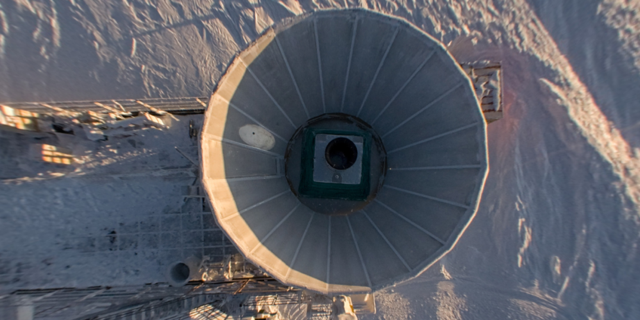
Figure 1: An aerial view of the BICEP2 experiment at the South Pole.

Remarkably, the large-scale Universe can be adequately described by a model involving only a handful of parameters. This lambda cold dark matter (LCDM) model postulates that the expansion of the Universe is driven by the presence of two dark components—dark energy and dark matter—and that the galactic structure we observe today was sourced by small density variations in the very early Universe. However, cosmologists expect that these primordial density fluctuations were accompanied by fluctuations in the fabric of spacetime itself. These gravitational waves could be observed through a predicted signal in the cosmic microwave background (CMB). The BICEP/Keck Collaboration, which has been a frontrunner in the search for this illustrious signal, reports on its latest data set, finding no evidence of gravitational waves [1]. The resulting limits push up against model predictions, which suggests that we are either quickly closing in on a detection or that we may soon witness a paradigm shift. In addition, the analysis shows that researchers properly understand the astrophysical contaminants that obscure the search for this relic signature. By reducing uncertainties about this contamination, we should have greater confidence in any future claims of a detection.

A robust detection of relic gravitational waves would confirm that our Universe was likely shaped by a mechanism known as inflation. Inflation was introduced in the early 1980s to solve some of cosmology’s biggest conundrums, and to this day, it is the most widely accepted and plausible theory of the early Universe. If that theory is correct and gravitational waves filled the early Universe, then cosmologists expect a distinct pattern, called B modes, should be imprinted in the CMB [2]. In 2014, the BICEP experiment at the South Pole (Fig. 1) reported possible evidence of B modes, but the signal turned out to be merely a result of dust in our own Galaxy producing CMB-like radiation. While this was a disappointment, it concentrated efforts on the dust problem (see Hunting Season for Primordial Gravitational Waves).

In principle, the CMB and dust can be distinguished because they differ spectrally. Over the years, researchers from the BICEP experiment and a joint project called the Keck Array have developed dust models using data at different frequencies. By removing the estimated dust contribution, the BICEP/Keck Collaboration has been able to place a progressively tightening bound on the gravitational-wave contribution. This bound is typically given in terms of the tensor-to-scalar ratio r, which characterizes the amplitude of gravitational waves relative to that of density waves. Before BICEP/Keck, the tensor-to-scalar ratio was known to be less than 0.11, based on CMB observations by the Planck satellite [3]. With BICEP/Keck data, the bound dropped to r<0.09 in 2016 [4] and then to r<0.07 in 2018 [5]. The latest result reduces the upper bound by almost a factor of 2, r<0.036 [1]. The BICEP/Keck team have shrunk this limit by combining data at three frequencies (96 GHz, 150 GHz, and 220 GHz) from their own experiment, complemented by archival data from the WMAP and Planck satellites.

Before commenting on the theoretical implications of this new upper limit, it is important to note how promising the latest analysis is for detecting a signal in the future. Since the foregrounds are the limiting factor to detection, accurate dust modeling is critical. Dust models are primarily based on high-frequency observations by the Planck satellite (the 353-GHz data to be precise). Dust becomes less important at lower frequencies, but for a small tensor-to-scalar ratio r, dust is still the strongest signal on the sky. If dust is more complicated than presently assumed, its modeling would need even more frequencies, or worse, perhaps the dust is too complicated to be modeled at all! For the first time, the observations place constraints on all the parameters of the dust model, and the team’s analysis shows that the model is accurately capturing the behavior of the dust. This is exciting news, as it suggests that we are in good shape when it comes to removing dust contamination and well equipped to make a detection if the signal is large enough.
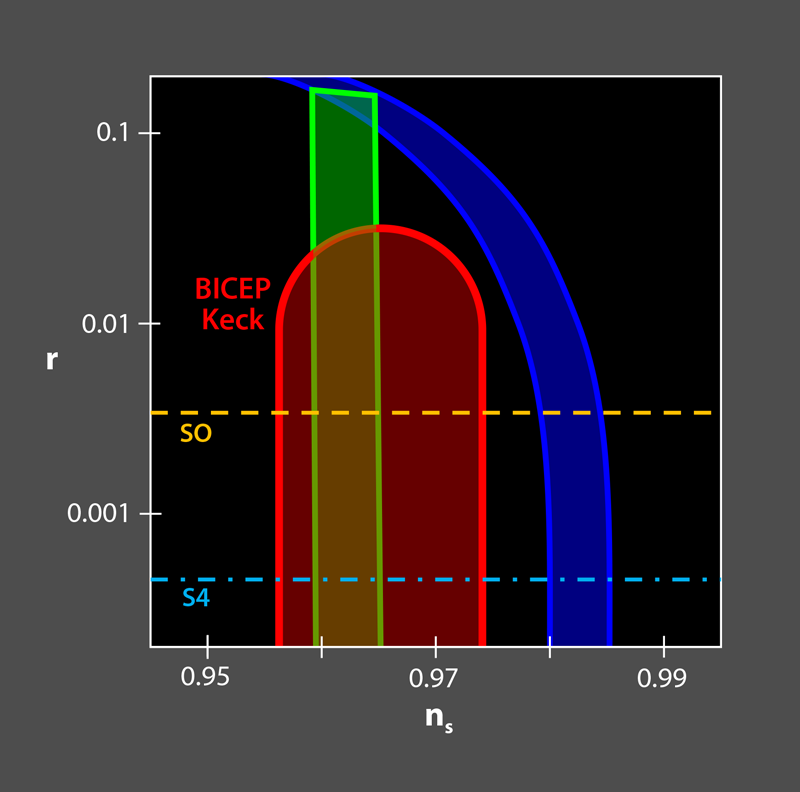
Figure 2: This schematic shows the new constraints from BICEP/Keck (red) on r, the tensor-to-scalar ratio, and ns, the scale dependence of the density fluctuations. Also shown are the predictions from certain inflation models: monomial or power-law models (blue) and Starobinsky-inspired models (green). The horizontal lines depict the expected sensitivities of future experiments: the Simons Observatory (yellow) and the CMB-S4 experiment (light blue). Show Less

These experimental efforts on dust removal are paying off, as the new bounds on the tensor-to-scalar ratio are having an impact on inflationary models. Different inflation models make different predictions for r, as the ratio is tied to the energy scale of inflation. One way to compare models with data is in a ns vs r plot, where ns is the scale dependence of the density fluctuations coming out of the inflation epoch (Fig. 2). The value that r takes within a particular inflation model is partly dependent on the amount of expansion before the end of inflation, characterized by the number N of e-folds (one e-fold corresponds to a stretching of space by a factor of e≈2.71). To solve the cosmological conundrums that inflation was designed to solve, N has to be at least 40, while values larger than 60 are inconsistent with measurements of ns. For a large class of popular models broadly referred to as monomial or power-law models, the tensor-to-scalar ratio is relatively large and scales as 1∕N [6]. We can now comfortably start to rule out this class of models. For another class of inflationary models, inspired by the work of Alexei Starobinsky in the early 1980s [7], the tensor-to-scalar ratio scales as 1∕N2 , leading to a smaller value of r that is within the new bounds from BICEP/Keck. Other models exist having r∝1∕Nt with t>2; however, those models tend to predict a value of ns inconsistent with current bounds.

So, some inflation models remain viable, but most of the popular models predict r>10−4 . While the new BICEP/Keck bound is still over 2 orders of magnitude away from this threshold, the rapid improvement over the last few years, combined with a much better understanding of the foregrounds, suggest we should soon be able to reach this theoretically well-motivated threshold. The future thus looks bright. Besides continued efforts by BICEP/Keck in close collaboration with the South Pole Telescope (SPT), the Simons Observatory (SO) in Chile, and later on, the CMB-S4 experiment (a joint effort by the SO and SPT/BICEP groups) will guarantee that we will reach the experimental sensitivity needed to measure r as low as 10−4 perhaps before the end of this decade. In addition to these ground-based experiments, a Japanese-led satellite mission, called LiteBIRD, will be launched in 2028. Satellites can observe the largest scales in our Universe, allowing them to probe a slightly later epoch than possible with ground observatories. If a detection is made, the combination of ground and space experiments will be paramount for confirmation. If, however, future measurements continue to find no gravitational-wave signal, it will likely imply that we must seriously reconsider our inflationary models or perhaps dismiss inflation altogether [8], which would be a significant paradigm shift.

References

  1. P. A. R. Ade et al. (BICEP/Keck Collaboration), “Improved constraints on primordial gravitational waves using Planck, WMAP, and BICEP/Keck observations through the 2018 observing season,” Phys. Rev. Lett. 127, 151301 (2021).
  2. M. Kamionkowski et al., “A Probe of Primordial Gravity Waves and Vorticity,” Phys. Rev. Lett. 78, 2058 (1997).
  3. P. A. R. Ade et al. (Planck Collaboration), “Planck 2013 results. XXII. Constraints on inflation,” Astron. Astrophys. 571, A22 (2014).
  4. P. A. R. Ade et al. (Keck Array and BICEP2 Collaborations), “Improved constraints on cosmology and foregrounds from BICEP2 and Keck Array cosmic microwave background data with inclusion of 95 GHz band,” Phys. Rev. Lett. 116, 031302 (2016).
  5. P. A. R. Ade et al. (Keck Array and BICEP2 Collaborations), “Constraints on primordial gravitational waves using Planck , WMAP, and new BICEP2/Keck observations through the 2015 season,” Phys. Rev. Lett. 121, 221301 (2018).
  6. V. Mukhanov, “Quantum cosmological perturbations: predictions and observations,” Eur. Phys. J. C 73, 2486 (2013).
  7. A. A. Starobinsky, “A new type of isotropic cosmological models without singularity,” Phys. Lett. B 91, 99 (1980).
  8. J. Khoury et al., “Ekpyrotic universe: Colliding branes and the origin of the hot big bang,” Phys. Rev. D 64, 123522 (2001).